 The Long Journey of a Wave
All scenes › Chapter 4 Breaking on the beach
When the seabed rises
As the seabed gets closer, circles flatten into ovals and waves slow down — try it yourself
View in 3DRaise the seabed
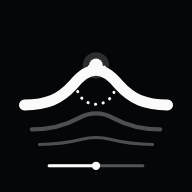
This time you can raise the seabed yourself. Use the “Water depth” slider to change how deep the sea is. Once the seabed is closer than half the crest-to-crest distance, the circles are squashed from above and below into flat ovals. Dots near the bottom move almost only back and forth. And the wave slows down.
Why?Water cannot move down through the seabed. So water near the bottom has less room to move up and down, and is only pushed forward and back. That is why the circles flatten.
Learn moreAn 8-second wave travels at 45 km/h in water 60 m deep, but at 32 km/h in water 10 m deep. At 60 m the surface circle is 100% as tall as it is wide — almost round — but at 10 m it is 71%, clearly flatter. Wave height on screen is drawn 2× larger.
- Crest speed at this depth
- 32 km/h
- 60 m deep
- 45 km/h · circle 100%
- 10 m deep
- 32 km/h · circle 71%
calculated from the textbook equations for water waves (linear wave theory)
View this scene in 3D →Read more
More in the series
The numbers come from the textbook equations for water waves (linear wave theory, the dispersion relation and shoaling). In the 3D view, wave heights are drawn larger; the seabed slope and the shape of breaking waves are rough sketches.